urban engitecture

Sustainability Paradigm for Safer, Healthier, and Connected Cities
At diffjustdiff we believe that the way forward for architecture at this time is its integration with engineering and urban design, in what we have come to call ‘macro-cities’ through what we call ‘urban-engitecture’.
The objectives of ‘urban-engitecture’ are clear: to contribute forcefully to achieving sustainability and quality of life in cities.
diffjustdiff basic (disruptive) idea is that buildings are obstacles that condition, limit and hinder us: both mobility in general and the quality of public spaces are directly affected by them in a very negative and permanent way. The solution we propose is to free the ground level by ‘elevation’. This simple idea also provides another series of additional advantages of great importance with respect to security, stability and quality of life conditions in general:
At present time (and since 2009) diffjustdiff mainly researches on the concept of macro-city.
diffjustdiff explores the actual possibilities in engineering, urban planning and architecture starting from simple issues such as building another type of city, drastically reducing pollution while improving living standards, guarantying structural stability despite considerable heights in high-raise building, fostering transportation and mobility at different heights, offering multiple escape alternatives in emergency cases, freeing the ground level for its use as public space, having good lightning, ventilation and sight qualities for everyone, generating community feeling.
Traditional flat urban designs have led to overcrowding, environmental damage, poor mobility, and even safety concerns. Building directly on the ground has limited the potential of cities, resulting in cramped spaces, inefficient traffic systems, and unsustainable practices. At Diffjustdiff, we’ve developed a new concept to address these issues: Urban Engitecture—a revolutionary approach to urban planning, where cities rise on elevated macrostructure-supported buildings.
This paradigm unlocks the ground level for public parks, green areas, and community spaces, while enhancing structural stability and safety. By lowering the slenderness of interconnected buildings, we provide greater resistance to wind and seismic activity. Moreover, multiple emergency exit options—sidewards, downwards, and even upwards—ensure safer and quicker evacuations in emergencies.
Urban Engitecture also significantly improves the living experience for residents. With buildings elevated and interconnected at various heights, all inhabitants enjoy better natural illumination, ventilation, and sightlines, ensuring that sunlight, fresh air, and unobstructed views are accessible to all. This boosts not only physical well-being but also mental health.
Additionally, our designs foster a strong sense of community and belonging. Shared spaces at various levels—such as rooftop gardens, elevated parks, and interconnected walkways—promote social interaction and create vibrant community hubs, bringing people closer together in their urban environments.
Mobility is drastically improved as well. Elevated walkways, bike paths, and seamless public transit systems reduce traffic congestion, making it easier for residents to navigate their cities. At the same time, sustainability is a core priority, with the use of eco-friendly materials, renewable energy, and energy-efficient designs that reduce the city’s environmental footprint.
Advantages of Urban Engitecture:
- Maximized Public Spaces: Ground levels dedicated to parks, green areas, and community hubs.
- Improved Structural Stability: Lower slenderness in buildings for enhanced safety and resilience.
- Better Natural Light and Ventilation: Brighter, healthier living conditions for all residents.
- Multiple Emergency Exits: Evacuation routes in all directions—sidewards, downwards, and upwards.
- Enhanced Community Feeling: Shared spaces that foster social interaction and belonging.
- Improved Mobility: Elevated walkways, bike paths, and public transit reduce traffic congestion.
- Sustainability: Eco-friendly materials, renewable energy, and climate resilience built into every design.
At diffjustdiff, Urban Engitecture isn’t just a new way of building cities—it’s a global revolution. By creating safer, more connected, and environmentally responsible urban environments, we’re shaping a brighter, more sustainable future for all. Join us in elevating cities and communities around the world!
Will small, one-off actions and initiatives push our society enough to achieve a real breakthrough preventing us from spiralling to our impending doom?
Could we make it without strategic urban planning and design being part of the solution?
The short answer,… is NO
…
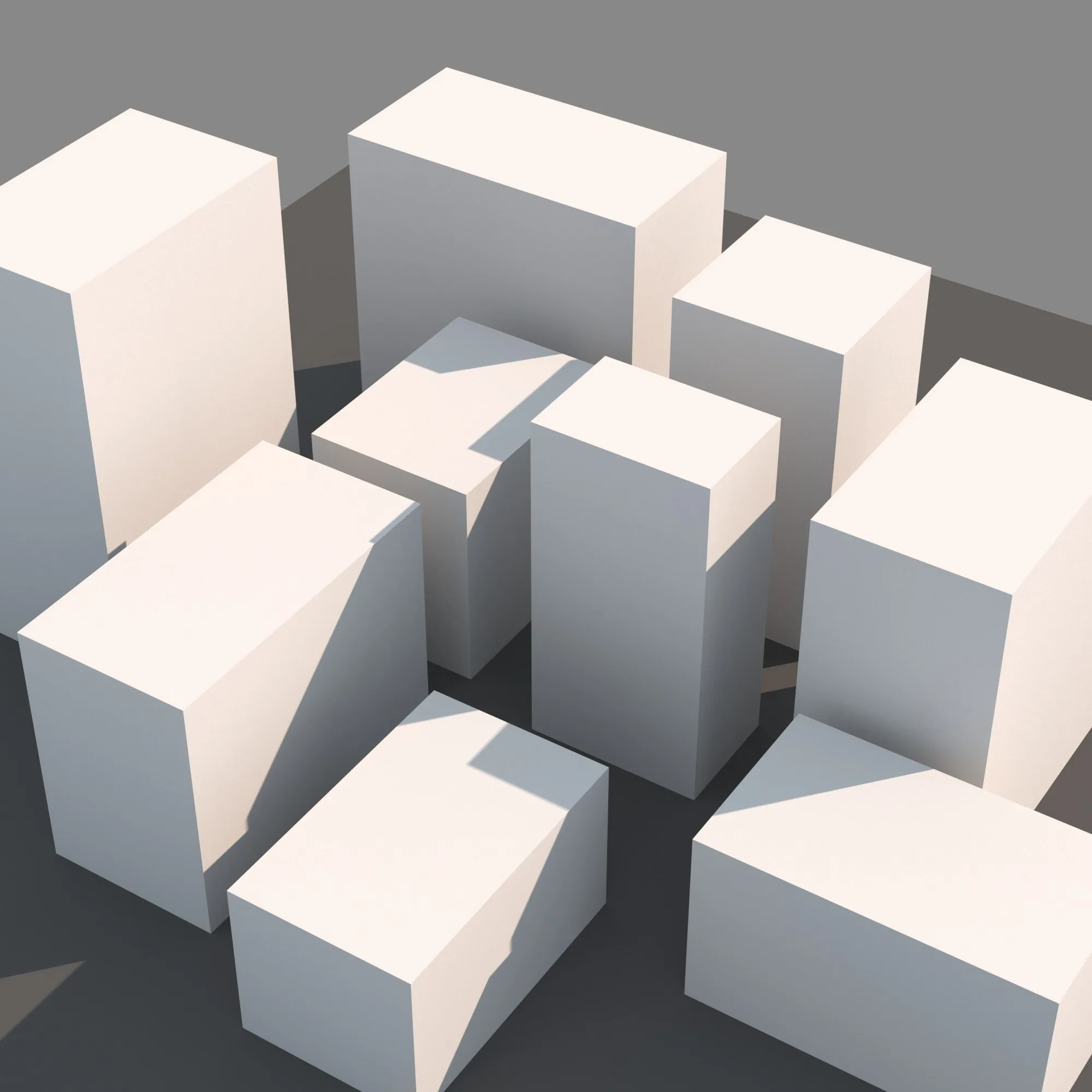

‘Urban-engitecture’ is the new sustainable paradigm we propose.
This new paradigm avoids current elements of unsustainability.
This new paradigm improves the way we do things.
Inside this new paradigm we can implement real sustainable life in the present and future.


The big problem of skyscrapers
The big problem of high-rise buildings is not their height (personally I am fascinated by heights), but their excessive slenderness (little base for a lot of height).
Slenderness is inversely proportional to its structural stability. The slenderer they are, the less structural safety and the greater the risk of collapse in the face of horizontal actions (forces) such as those caused by earthquakes or winds. I think the exposition is, so far, clear and sufficient:
- The big problem with tall buildings is not their height, but their narrowness, which leads to structural instability.
In my opinion, structural stability is a fundamental characteristic and of great importance to guarantee the life (survival) of its inhabitants/users. Perhaps the most important and priority question in architecture, above any other argument or interest.
The next point would be how to solve/avoid this serious structural and public safety problem of high-rise buildings. The answer is also simple:
- If, instead of building ‘isolated’ high-rise structures, we built them horizontally interconnected at different heights, we would make them function as a single superstructure, greatly limiting horizontal displacements due to earthquakes or winds, and largely avoiding the possibility of overturning and/or collapse.
Additionally, these horizontal ‘connecting’ elements at different heights can be used as ‘bridges’ of communication between one building and another, as high-rise public spaces, or any other use that our imagination may suggest to us, like, for example, providing multiple sideward escape options in emergency cases.
Could we see skyscrapers as huge supports?
- How about connecting skyscrapers limiting their movement and improving their stability?
- How about having green public spaces and communications between them?
- How about providing upwards and sidewards escape option in emergency cases?
- How about enhancing community feeling/belonging by shared open spaces?


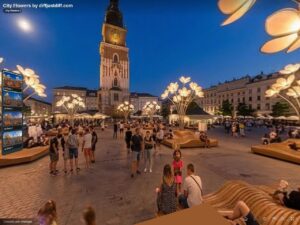
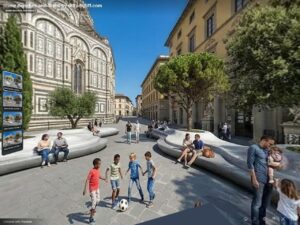
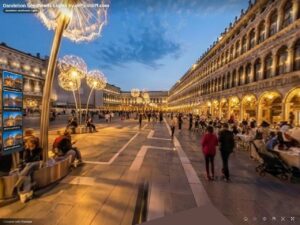
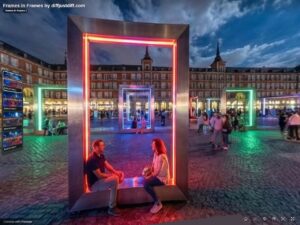
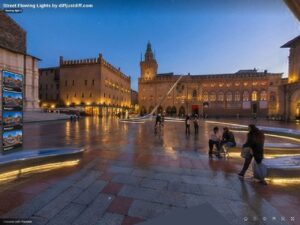
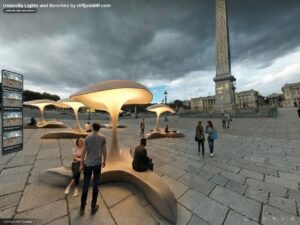
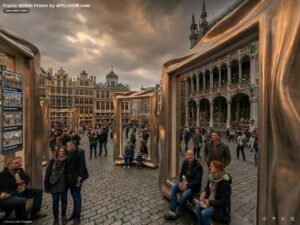
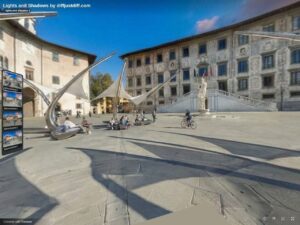
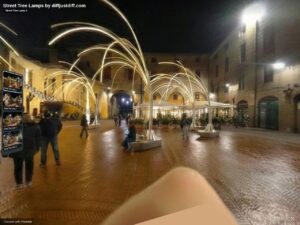
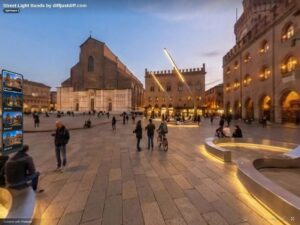
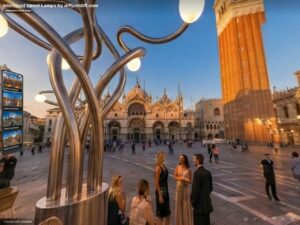
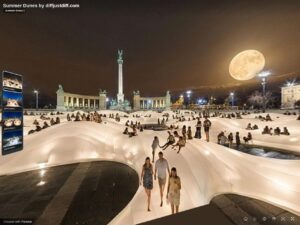
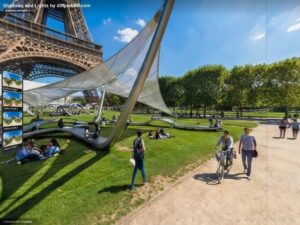
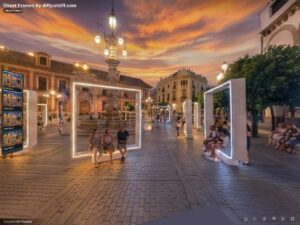
urban furniture
360º vision
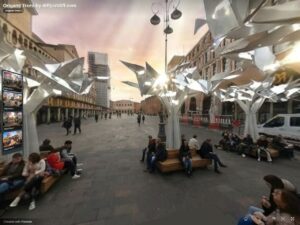
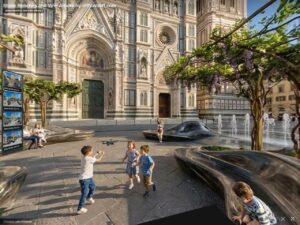
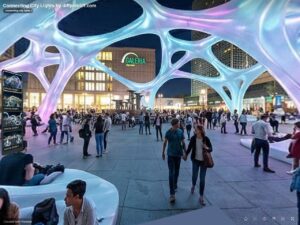
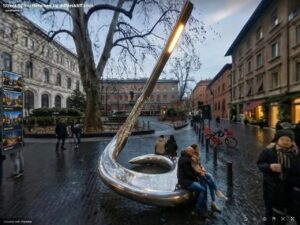
___For something to become real, at first there must be a dream …
The act of design is an act of creation.
Imaginative processes utilize speculative thinking methods that are similar to those present in the making of dreams.
When we imagine, we invent unreal scenarios that are near to dreams.
When we design we utilize our imagination as a form of visualization of possible reality. Thought becomes speculative, situated outside reality. In this way we have the necessary freedom to create a new reality, a new entity, which until that moment had been non-existent and unthinkable.
Are aesthetics functional? Yes.
Who would not want to work in a nice and special place? And to reside in one? And to be in one?
Aesthetics, along with environmental factors, produce a sensation of well-being within us. Aesthetics make us feel better with our environment, physical and human, and with ourselves. Well-being is translated in a minor tension between our interior and the exterior. It improves our capacities of relation, reflection, tolerance, interaction, assimilation, coexistence, and ultimately, of efficiency and productiveness. Aesthetics are related to beauty. Beauty is related to health. Through aesthetics we create beauty, and through beauty, we create health.
In the absence of aesthetics, both physical and human environments degenerate into passiveness and indifference, or even worse, they degenerate into aggressiveness and intolerance.
By investing in aesthetics, we also invest in functionality.


published books
realism-s™ — (cad & ai) digital sketching
by Ale Girá
free to download | paper copies available at amazon.com/author/alegira/
realism-s — abstract
A visual exploration of what architecture, urbanism and engineering could become when generative AI enters the design studio as a partner rather than a substitute. Across six interlinked volimes, this series gathers digital sketches that probe the edges of the possible — ab-realism, diff-realism, future-realism, inner-realism, another-realism, new-realism, super-realism, real-realism, un-realism and in-realism.
The books are a working document, not a finished thesis. The aesthetic is deliberately exploratory: organic shapes, nested cores, treehouse typologies, circular and flowing massing, floating and lifted blocks, layered urban fabric — all generated through successive iterations of image-to-image and text-to-image prompting, and all understood as links in an ongoing chain of trial and error.
Rather than “final” designs, what you’ll find here are proposals in the ‘r-evolution’ sense the author argues for in the foreword: provisional, transitory, deliberately open to the next version. The cad & AI are the sketchpad.
realism-s — intentions
My intention with the series ‘realism‑s ™’ is not to carry out a thoughtful work, or a historically documented exposition. ‘realism-s ™’ is a continuation of my previous publication entitled ‘Hyperirrealism’, which contains the ideas that drive all my work, including this one.
I believe that architecture is saturated with intellectualism, with the need for models/references from/to the past and with arguments that help little or nothing to solve the real problems we face.
Furthermore, I am more interested (and I think they are examples of a more advanced mentality than architecture) in the way in which other arts are produced, manifested and appropriated by their recipients, such as music, literature, plastic arts, and even the scenic ones. In them, the freedom of creation and its meanings are not controlled in the way that architecture is. The reasons for this may be many, but I believe that architecture education and many political and economic interests sustain this ‘status quo’ of architecture in which creativity is hijacked by inherited ‘intellectualities’, ‘fears’ of what they will say, limiting ‘doctrines’, etc. (and many, far too many, economic and political interests).
For these reasons I present this publication in a fundamentally graphic, ab-referential and voluntarily ‘light’ way. I do not intend with it to satisfy any critical group, or any of the previously mentioned interests.
Voluntarily, the chapters that follow reflect and simulate a succession of ‘posts’, entries, the way in which information is currently disseminated and acquired on social networks.
The purpose of this work is that of trying to be helpful (in some way) to solve the serious problems that we are currently facing in the urban and architectural conception with respect to the quality and sustainability in urban environments.
hyperirrealism™ — digital sketching
by Ale Girá
ORO Plublishers | Hyperirrealism ™ |


hyperirrealism — abstract
Hyperirrealism aims and confronts the generation of a new architecture and urban planning for the 21st century. To achieve this, two simultaneous working lines are developed: Theoretical and graphical/structural.
Thesis Dis-order researches contemporary human mind architecture, utilizing disorder as a way for finding new possibilities to individual and collective identities.
Digital Sketching is geometric expression and synthesis of contemporary human nature theoretically exposed: Architectural and urban ideas, designs and solutions to nowadays problems, validated by a structural behavior study that concludes their feasibility and stability.
These two design lines are incarnated into the actual world as a crystallization of the current historical moment where disorder and order produce (r)evolutions perpetually, more accelerated and varied individually and collectively.
about
_diffjustdiff, a statement
At diffjustdiff we always ask ourselves how can we contribute to the real sustainability: Is short-term thinking the way to reach that sustainability? How can we pave the way for sustainability towards a real common good? Are our buildings and cities offering good enough living conditions? Can ‘a different urban planning & architecture’ guarantee a long-term human (and humane) ecological living?
diffjustdiff has criticism and self-criticism as base tools in the process of troubleshooting. Criticism toward current shot-term systems in use gives diffjustdiff an external and independent point of view which allows its ideas and projects a wide span from their bases to the utmost prosperous and sustainable horizons. Self-criticism helps us not to end-up absorbed by day-by-day praxis, habits and uses typical in those short-term systems with no interest in the long term.
diffjustdiff offers an alternative view counting on solutions that are ambitious, but not because of that impossible.
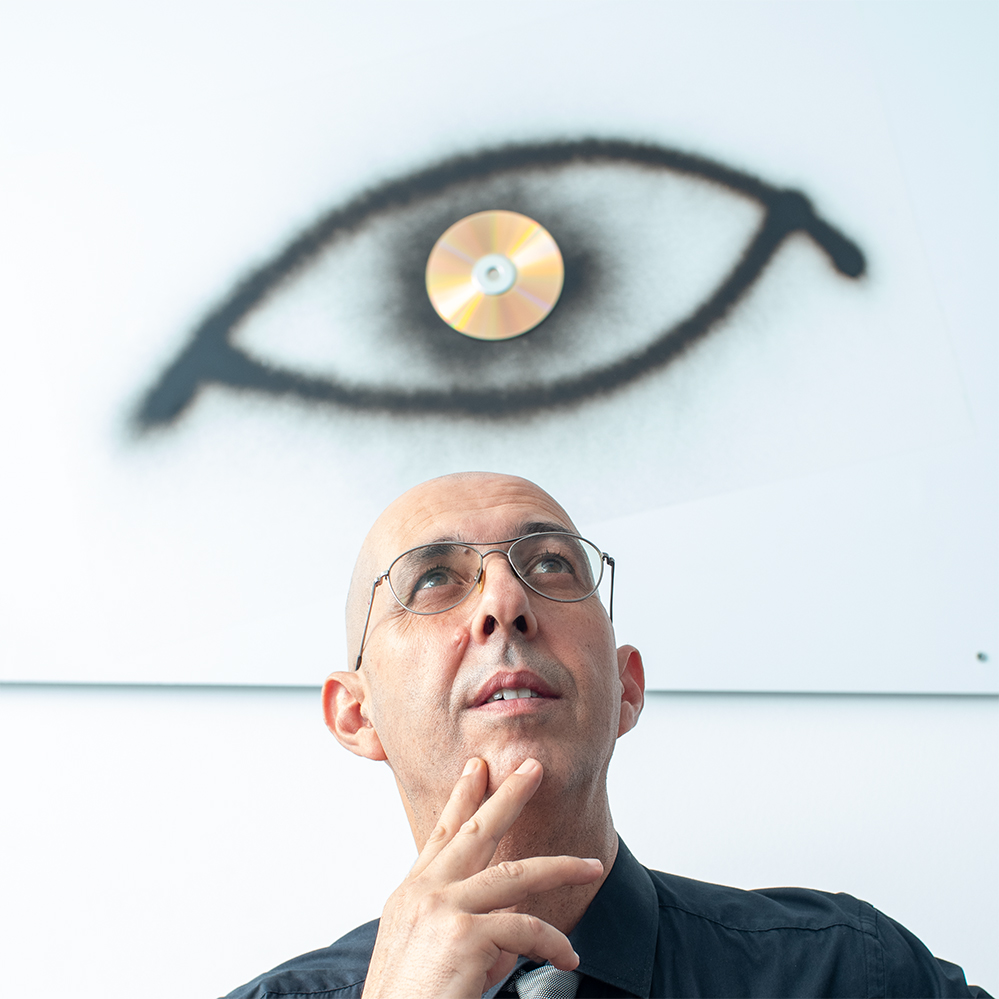
PhD Architect from the University of Seville, vocational architect since a very early age; he always believed in the importance of architecture as a generator of a big part of the reality we live in.
He attained his Degree in Architecture in Seville (Spain), and completed his studies in other countries and cities; before undertaking his studies in Architecture he attended in 1991-92 the Pre-University course in New Jersey (US). Later on, in 1996-97, he was awarded a scholarship within the ‘Erasmus’ exchange program which led him to the University of Venice (Italy), where he attended lessons given by Aldo Rossi.
Once he had completed his studies at the University of Seville, the Camuñas Foundation (Centre for Higher Education in Architecture) of Madrid (Spain) awarded him a scholarship in 2004-05 for a Master Degree in Virtual Architecture. The knowledge acquired there gave him the opportunity to achieve in 2008 a European Exchange ‘Leonardo’ scholarship, awarded by the Architectural Association of Architects of Seville, that took him to Hannover and Hamburg (Germany) where he worked with Professor Andreas Uffelmann.
In 2009-10 he attended the Master’s Degree of ‘Innovation in Architecture: Technology and Design’ at University of Seville (Spain) finishing those studies with honors. His unceasing research in architecture reached its highest point with his PhD lecture in 2012 at the Department of Structural Design of the Higher School of Architecture of the University of Seville (Spain) – where he achieved the qualification of Cum Laude -, being this a compendium of his works up to that date; the PhD brought him to teach Architecture and Urban Planning at the Southwest University of Science and Technology of Miangyang (China) in 2013, where he widened his thesis with new projects and writings.
In 2020, Oscar Riera Ojeda published his first book entitled ‘Hyperirrealism’, a compendium of 15 years of his previous production. Later on, he published a condensed new edition of ‘Hyperirrealism’ with its most notable content entitled ‘(@- + i-) realism-s’.
ale girá has continued to impulse his research and development, until a new books series entitled ‘realism-s’, supported by Artificial Intelligence and based on his previous work.


