
Urban Engitecture
“I think both main problems are caused directly by buildings, which I compare to obstacles: they hinder movement and they take space away from the public.”
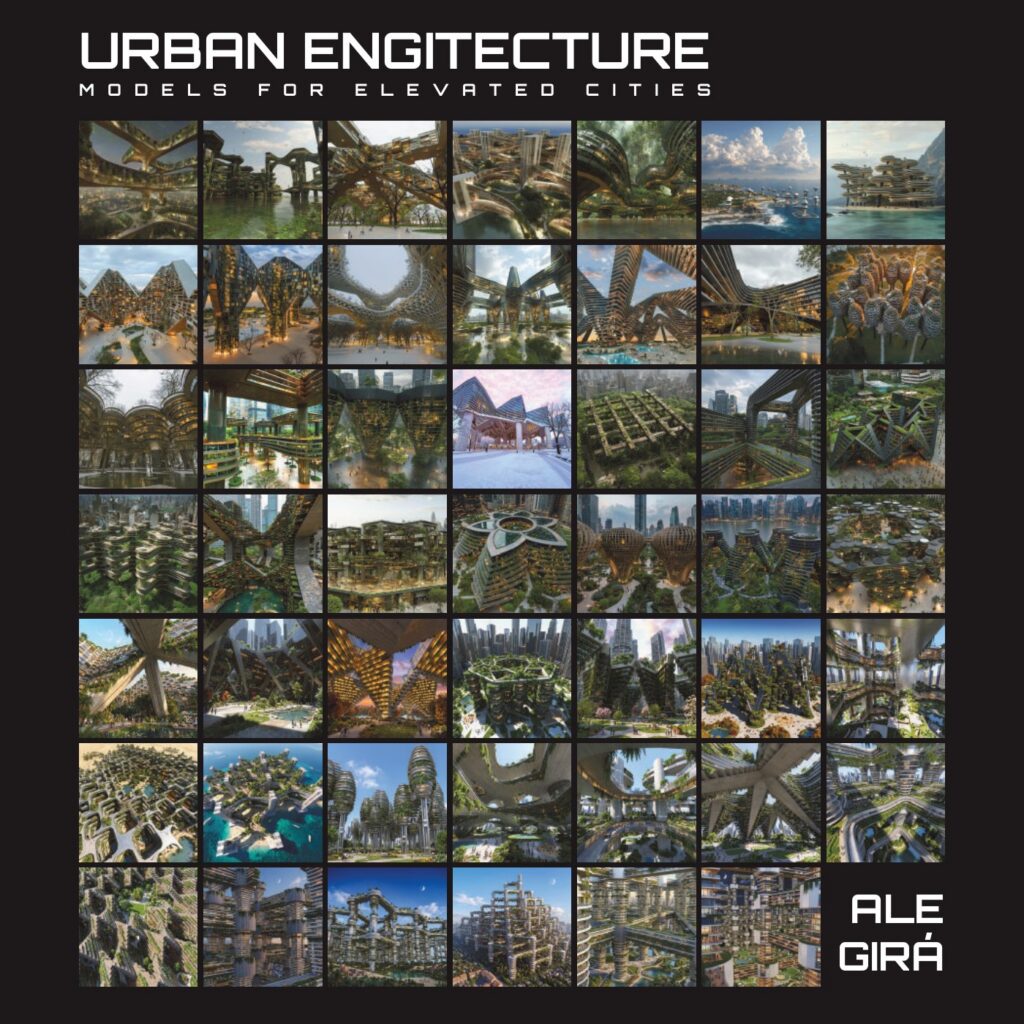
The Urban Engitecture book is a collection of experimental models for elevated cities. It applies the logic of structures to the scale of the city: vertical buildings as supports, horizontal buildings as beams, curved forms as arches. Connected at the top and lifted above the ground, buildings free the ground level for parks, mobility and public life.
These are digital sketches, modelled first in CAD and then developed with AI. The 48 projects, from Layers, Nets and Bridges to Honeycomb-Oasis, Star-Island and Cubic-Lattice, come with 32 short texts that explain the idea behind the models, and a project index and a separate text index let you read the images and the ideas on their own. Projects sit on black pages and texts on white ones. Free to read here, with paper copies on Amazon.
The foreword begins with a caveat, “I am not a sustainability expert”, and then names two main factors that make today’s cities unsustainable: mobility problems, and public spaces that are poor or insufficient. Both, it argues, are caused directly by buildings, which it compares to obstacles. Lifting them above the ground removes the two causes and can make neighbourhoods more livable, so the models explore futuristic architecture and urban design concepts for the elevated city, offered as questions rather than answers.
The 32 short texts read as a primer on the elevated city: Buildings as obstacles, Elevate the city, Giving land back to nature, The problem of tall buildings is slenderness, not height, Connect the towers, Several ways out, Macro-structures and Seven questions for a macro-city. One is titled What these designs do not claim; it names the challenges (higher costs, complex structural geometry, the need for efficient inclined transportation) and asks that the images be read as experimental digital sketches and nothing more. The book closes with a question: is it worth designing cities this way?